 Principles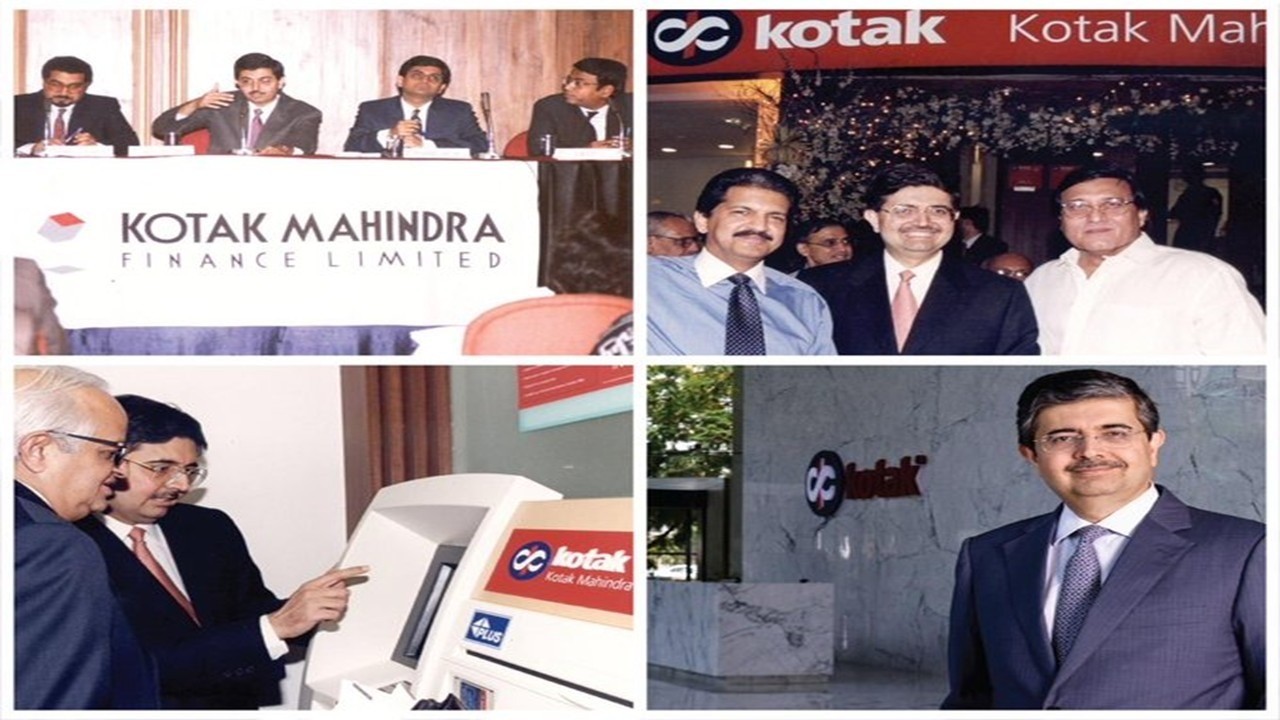
Kotak Mahindra Bank marks a rare milestone in 2025: approximately 40 years since its founding in 1985 and 30 years as a publicly listed institution on India's stock exchanges. Few corporations, let alone financial institutions in a competitive banking sector, navigate three decades of public ownership with consistent value creation, let alone four decades of institutional existence. This longevity itself tells a story of resilience, leadership, and what Uday Kotak calls "trusteeship."
A 30-Year Proof of Compounding Through Turbulence
For those who entrusted capital to Kotak Mahindra Bank at its December 1995 IPO, the results have been extraordinary: a 22.11% compounded annual growth rate (CAGR) over nearly three decades, turning ₹10,000 into nearly ₹39.5 lakhs by November 2025. Yet this journey was far from smooth or predictable.
Investors faced nineteen separate drawdowns exceeding 20% from peak to trough, roughly one major shock every 1.5 years:
· October-November 2003: An 83% crash in just 44 days (₹19.70 → ₹3.35).
· 2008 Global Financial Crisis: A 70% collapse over 178 days (₹359.50 → ₹107.53).
· Additional severe corrections in 2002, 2006, 2009, 2011, 2013, 2018, 2020, and multiple periods where the stock remained essentially flat for a year or more.
These weren't minor technical pullbacks; they were wealth-destroying events that forced investors to confront the painful gap between stock price and business value.
In order to understand Kotak's achievement, consider what happened to its peers. Since India's 1993-94 banking reforms, at least a dozen private sector banks have folded or required rescue: Global Trust Bank (2004), Bank of Punjab, Centurion Bank, United Western Bank, Bank of Rajasthan, Yes Bank (2020 rescue), Lakshmi Vilas Bank (2020 collapse), and several others. In that same period, many competitors’ promising faster growth, aggressive expansion, and higher short-term returns have simply ceased to exist as independent entities. Kotak not only survived; it thrived by prioritizing asset quality over expansion and governance over shortcuts. The Architecture of Trusteeship
He attributed the bank's longevity to a deliberate commitment to stewardship. In his letter to shareholders dated July 14, 2023, he articulated the philosophy that underpins three decades of institutional resilience. This isn't rhetoric. With nearly 26% of his personal and family wealth concentrated in the bank, Kotak's interests are inextricably aligned with those of every shareholder. The average CEO tenure in India is merely 3.4 years, compared to 5–7 years in the US and FTSE 100 (Russell Reynolds, 2024). Against that backdrop, Kotak's four-decade commitment is extraordinary.
The Institutional Investor Perspective
During my tenure as a fund manager at ING Mutual Fund, when ING Group held a 3% stake in Kotak Mahindra Bank from 2007 to 2010, I had the rare privilege of engaging directly with Mr Kotak. The experience was illuminating, not because of eloquent pitches or carefully crafted guidance, but because of what I observed: a leader practicing trusteeship as a daily discipline, not deploying it as marketing language.
The Enduring Lesson
Three decades into public markets, the greatest lesson from Kotak's journey is this: long-term wealth is created not by those who promise the most, but by those who endure through every cycle and maintain trusteeship through volatility. For serious investors seeking to navigate market cycles and capture generational wealth, the message is unambiguous: Kotak Mahindra Bank's four-decade journey is not just a financial achievement; it is a masterclass in the rarity, difficulty, and ultimate triumph of genuine trusteeship
Manish Bhandari, CIIA, founder of Vallum Capital Advisors, a Portfolio Management firm managing equity investments for Family Offices, NRIs and HNIs, serves as a Board Member of the Association of Portfolio Managers in India. Based in Mumbai, he can be reached at manish.bhandari@vallum.in.